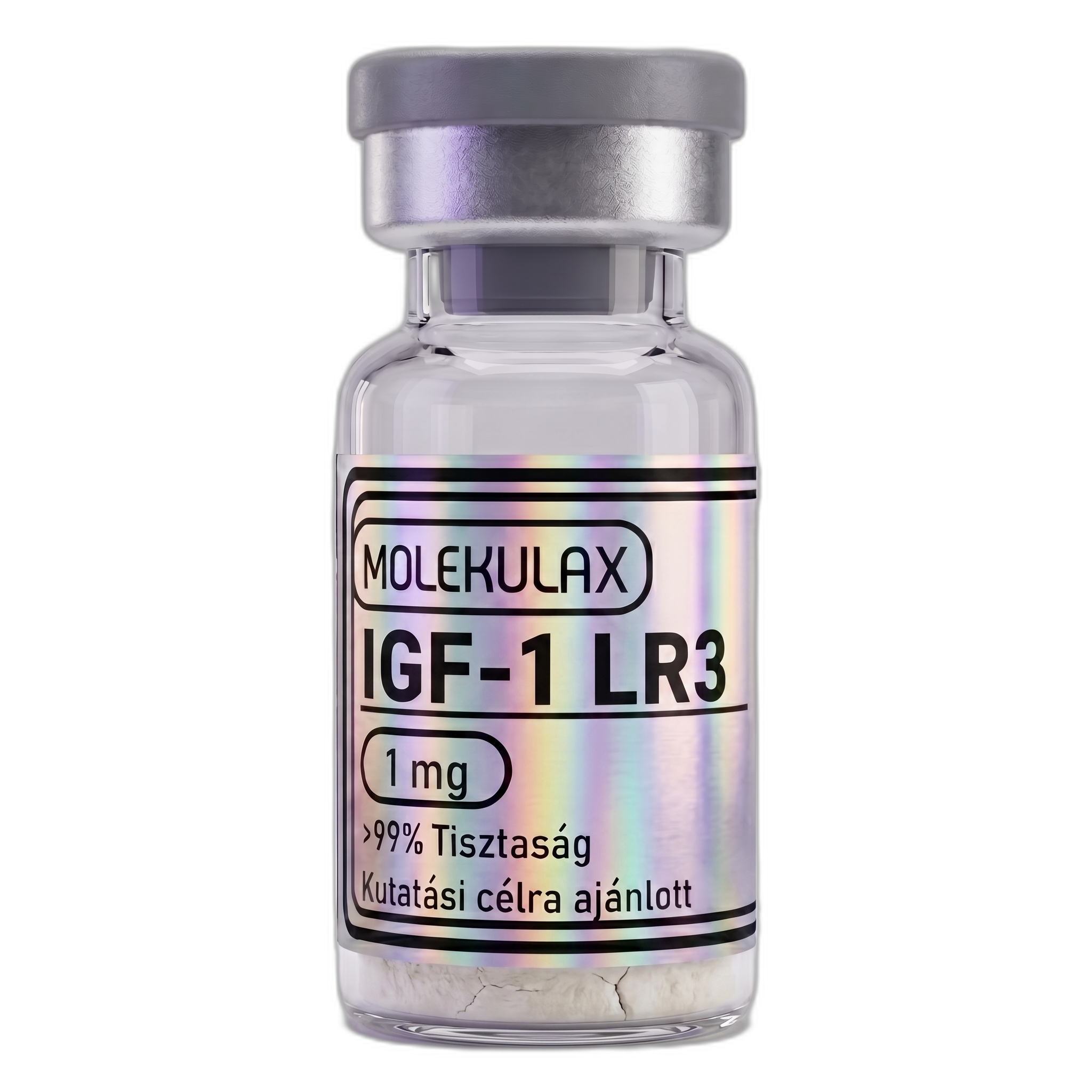
IGF‑1 LR3
Experimental peptide: a slower-degrading, more active version of the growth-stimulating IGF-1; not proven in humans.


The links above are labelled third-party affiliate links. MolekulaX does not sell and does not verify product quality.
DETAILED OVERVIEW
What is IGF-1 LR3?
IGF-1 LR3 (Long Arg3 IGF-1) is an experimental peptide, a modified version of IGF-1, a hormone that stimulates growth in the body. Because of the modification it breaks down more slowly than the original hormone. It is currently considered a research compound.
It binds less to the proteins that trap IGF-1 in the blood, so more of it stays in an active, free form and it conveys a tissue-building (anabolic) signal. It has so far been studied mainly in animals and is not proven in humans.
Type
IGF-1 analog
Structure
83 aa, Arg3 substitution + N-terminal extension
Status
Research
Route
SC
Storage
2–8°C
Growth hormone release
The peptide acts on pituitary GHRH or GHS receptors, producing a physiological, pulsatile GH release, unlike synthetic rHGH, which keeps levels flat and leads to desensitization. IGF-1 rises into the upper-normal range, driving recovery, muscle protein synthesis, lipolysis and skin quality. Deep-sleep phases lengthen; collagen and bone-matrix synthesis activate. The effect is reversible and does not suppress the endogenous GH axis.
Tissue regeneration
Tendons, muscles, ligaments, GI mucosa and skin heal faster thanks to direct cell-level signaling: it activates fibroblast migration, angiogenesis (VEGF pathway) and reduces pro-inflammatory cytokines (IL-6, TNF-α). Chronic, slow-healing injuries see functional improvement; pain and swelling drop. Post-workout recovery windows shorten by 30–50%, allowing more training volume. Effects are documented even in enthesopathy, tendinitis and GI ulcers.
IGF-1 LR3 is widely discussed but considered relatively weak compared to Tesamorelin or HGH in many user reports, though it has specific use cases. LR3 binds less to IGF-binding proteins and shows reduced hepatic sequestration compared to native IGF-1, allowing more systemic activity. Metabolically, it overlaps with insulin signaling, so glucose levels can drop – producing muscle fullness in some users but also potential hypoglycemia symptoms. The growth pathways it activates (Akt/mTOR, Erk) are fundamental cell-growth signals, not muscle-selective, so long-term use warrants caution. Compared to IGF-1 DES, LR3 functions as a sustained systemic growth signal rather than a targeted one. Opinions in the community are mixed: useful for some, considered ineffective by others.
Dosing varies and is usually small. LR3 has a substantially longer duration than native IGF-1 due to reduced protein-binding affinity. Starting low and assessing response is recommended.
⚠ Not clinical evidence – based on user accounts.
Data console
Lab data
Research indications
Investigated uses and mechanisms
Growth hormone release
Mimics physiological pulsatile GH secretion; IGF-1 rise.
Recovery & body comp
Muscle mass gain, fat reduction, post-workout recovery.
Sleep quality
Deep-sleep (N3) phases lengthen.
Reconstitution
How to prepare, step by step
Important
Sterile technique required. Use bacteriostatic water (BAC) only. Never distilled or tap water.
- 01
Remove the vial and bacteriostatic water (BAC) from refrigeration; let them reach room temp for 5 minutes.
- 02
Wipe both vial stoppers with an alcohol swab.
- 03
Draw 1 ml of BAC water into a sterile syringe (typical for the 1 mg vial).
- 04
Inject slowly down the side of the vial, do NOT spray directly onto the peptide powder.
- 05
Swirl gently in a circular motion until dissolved (~30 s), do not shake.
- 06
Wait for the solution to become clear. If sediment or discoloration appears, discard it.
- 07
Label the vial with reconstitution date and concentration.
- 08
Store at 2–8 °C, protected from light. Inspect visually before each use.
Quality indicators
How to recognize a pure peptide
Purity markers
4White / off-white powder
Typical appearance of sterile lyophilized peptide.
Comes with COA (Certificate of Analysis)
Independent lab analysis, ≥98% purity.
Intact, sealed vial
Rubber stopper + aluminum crimp intact, ensuring sterility.
Dissolves clear
Clear solution after reconstitution, no sediment.
Use caution
1Storage temperature
Extended room-temp exposure may reduce potency.
Do not use
2Discoloration / sediment
Yellow, cloudy or particulate solution, indicates degradation, do not use.
Damaged packaging
Cracked vial or loose cap, sterility compromised, discard.
Safety
Side effects, stop signs, contraindications
Side effects · 5
- Injection-site redness, itching
- Water retention, mild edema
- Wrist / joint stiffness (carpal-tunnel-like)
- Transient blood-glucose increase
- Mild prolactin / cortisol increase (some peptides)
Contraindications · 5
- Pregnancy and breastfeeding
- Active malignancy
- Known allergy to the peptide or its components
- Severe hepatic or renal impairment (medical consultation required)
- Age under 18
Related Peptides
Same therapeutic category
Telegram
Have a question about IGF‑1 LR3?
Reach out to an advisor on Telegram. We can help you find the right peptide.
Personalized consultation
Want a detailed conversation tailored to your data?
Fill out the prep intake form (your goals, training and health data), and the advisor prepares from it to give genuinely personalized guidance.
Fill out the form~5–7 min · prep questionnaire · confidential · GDPR-compliant
The information here is strictly for educational and scientific purposes. It does not replace medical advice or clinical consultation, and it does not encourage illegal substance or pharmaceutical use. Data is sourced. When in doubt, consult your doctor.